
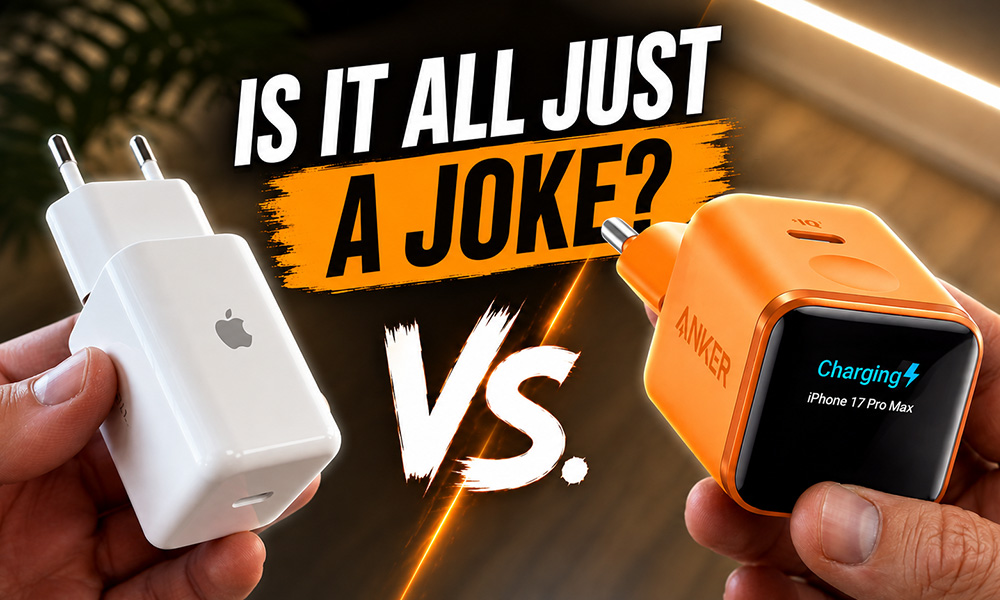
Anker’s new Smart Nano charger promises more than just faster charging — it claims to detect your specific smartphone model and lower battery temperature by up to 5 degrees, which according to the manufacturer extends your battery’s lifespan. Sounds almost too good to be true. So I actually measured it, head to head against the original Apple charger.
The Setup: Two Phones, Two Chargers, One Power Meter
To keep this fair, I brought both the iPhone 17 Pro Max and the Galaxy Z Fold 8 to exactly 10 percent battery and charged them simultaneously — once with the Anker Smart Nano in its „Breathing“ gentle-charging mode, once with the original Apple charger. A power meter measured the actual wattage flowing through, and an infrared thermometer tracked the real battery temperature, always measured from the same distance.
The Anker charger claims up to 45 watts, the Apple original up to 35 watts. But that’s not really what this test is about — the real question is how hot the battery actually ends up getting.
Is your phone really charging at full speed?
My Charge Check tells you in two minutes whether your charger, your cable or the charging protocol is holding you back – photograph the charger, pick your phone, done. Free, no app, right in your browser.
Round One: The Underwhelming Numbers
The results were disappointing right from round one: instead of the promised 45 watts, the Anker Nano in gentle mode never went above 32 watts, quickly dropped to 27 watts, and later settled around 18 watts. The Apple charger delivered a similarly modest 28 watts, despite the iPhone 17 Pro Max being capable of up to 40 watts.
And the temperature? After several minutes of charging, both devices sat at nearly identical 37–38 degrees — regardless of which charger was plugged into which phone. The gentle-charging mode that’s supposed to deliver up to 5 degrees of difference was simply not measurable in practice.
Swapped Them, Measured Again — Same Result
To be thorough, I then completely swapped the chargers and also disabled adaptive charging on the iPhone. The result stayed the same: no matter which charger was plugged into which phone, the temperatures barely differed, usually within a few tenths of a degree. At one point, charging power even dropped below 1 watt — likely because both devices were already too warm at that stage and charging got throttled automatically to almost nothing.
The Extreme Test: Charging While Recording in 8K
For the final stress test, I had both phones record video at their highest settings — the Galaxy Z Fold 8 in 8K, the iPhone in 4K — which genuinely drains the battery fast and heats the devices up significantly. After three minutes of recording, both were already sitting around 40 degrees. Then I plugged the chargers back in: in the end, the Fold 8 showed 43 degrees, the iPhone 42 degrees — again, essentially no meaningful difference between the Anker Smart Nano and the Apple original.
By the way, this is also a good reminder why solid screen protection matters if you’re testing your device hard or just using it day to day — if you’re still looking, check out my current iPhone 17 Pro screen protector comparison for the best options right now.
Why „Smart“ Charging Barely Makes a Difference
The reason is actually pretty simple: it’s not the charger that ultimately decides how hot your battery gets — it’s your smartphone. Modern devices constantly and automatically regulate charging power, throttling it as the battery warms up. A charger simply can’t push through more power than the phone is willing to accept, no matter how „smart“ it markets itself as. That’s exactly what I saw live in this test: both chargers ended up getting throttled almost identically by whichever phone they were plugged into.
Temperatures under 30 degrees are generally considered especially gentle on a battery, while values above 40 degrees accelerate the chemical aging processes inside — which is why manufacturers regulate so aggressively. That’s also why a 45-watt charger isn’t automatically more damaging than a 20-watt one: what matters is how efficiently the charger operates and how much heat actually builds up inside the phone, not the raw wattage printed on the box.
My Verdict
After this thorough test, I can honestly say: I couldn’t find any measurable difference between the Anker Smart Nano in gentle mode and the original Apple charger — not in temperature, and not in actual charging power. The build quality of the Anker charger is genuinely good, and the little display with live wattage readout is a nice touch, but the core claim — up to 5 degrees cooler charging — never held up in any of my tests. In the end, your smartphone controls the charging process itself, regardless of how „smart“ the charger plugged into it claims to be.
If you’re charging your iPhone 17 Pro as often as I did during this test, it’s also worth thinking about a solid case — my current roundup of which case protects best covers the models that hold up reliably.