
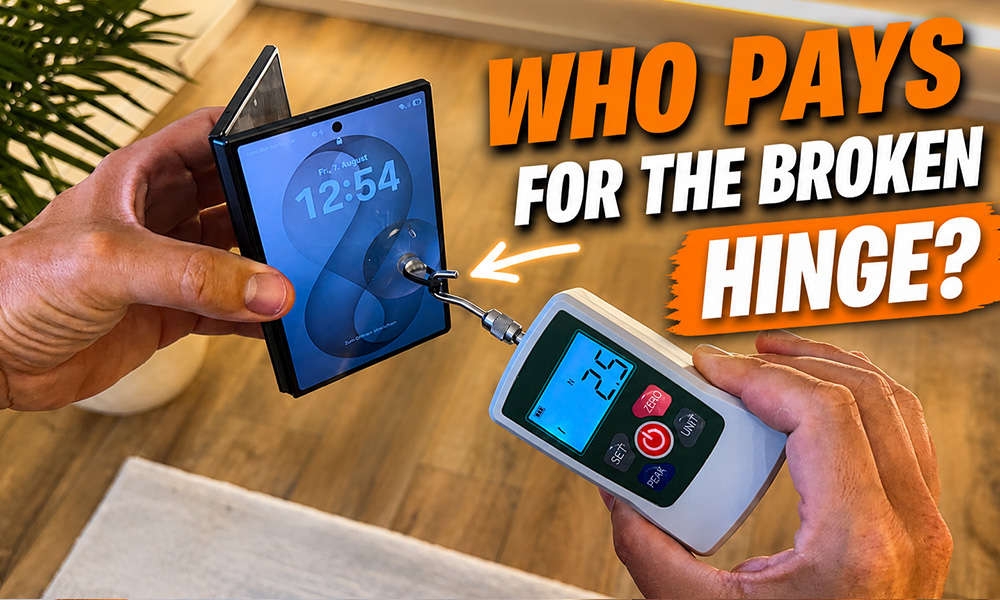
Anyone considering a fold smartphone, or who already owns the Galaxy Z Fold 8, eventually asks the same questions: How long does the hinge actually last? Does it loosen up over time? And what happens if it breaks — does the warranty cover it, or do you need extra insurance? This information is surprisingly hard to find online. So I decided to do something nobody seems to have done yet with the new Galaxy Z Fold 8: measure, scientifically, exactly how quickly the hinge shows signs of fatigue — using a pull-force gauge that measures the opening force in Newtons.
What Samsung Officially Says About the Hinge
Samsung states that the Z Fold 8’s hinge is rated for 500,000 open-and-close cycles. That number sounds abstract, so I did the math: if you fold the device 100 times a day, 500,000 cycles works out to roughly 13 years of use. That’s genuinely impressive. My test of 1,000 folds represents just 0.2% of that official rated lifespan — in theory, nothing should have changed at all afterward.
The Test Setup: How Do You Actually Measure Hinge Wear?
To keep the exact same position throughout all 1,000 folds, I mounted the Z Fold 8 using a suction cup and a MagSafe stand — since the device itself doesn’t have MagSafe, I used a MagSafe-compatible case to make that work. I attached a hook to the top of the device, connected to the pull-force gauge, so I could precisely measure how much force in Newtons is needed to open the display.
Before the actual stress test, I took five measurements and calculated the average: 2.6 Newtons, ranging between 2.5 and 2.8 Newtons. That was my baseline for comparison after the endurance run.
1,000 Folds — Live and Sped Up
Then it was time: 1,000 open-and-close cycles, condensed into a time-lapse in the video. The first 500 folds took me exactly 10 minutes, and my hands were genuinely sore afterward. After a short break, I did the remaining 500 — actually a bit faster this time, since I’d gotten into a rhythm. The hinge itself never got warm. At two points out of the 1,000 folds, I noticed a slightly sticky feeling, as if something was briefly caught inside — an isolated occurrence that didn’t repeat.
The Result: Is There a Measurable Difference?
After the 1,000 folds, I ran the second round of measurements — and this is where it got interesting. Instead of the previously consistent readings around 2.6 to 2.7 Newtons, the gauge now repeatedly showed 0, or values below 2.5 Newtons, the lowest value the device can register. In other words, the display was now opening with less force than before — a clear sign that the hinge already moves slightly more freely after just 1,000 folds compared to its factory-fresh state.
Important context: subjectively, in day-to-day use, the hinge still feels exactly the same to me. The visible crease in the middle of the display hasn’t visibly deepened after the 1,000 folds either. The most likely explanation for the changed Newton readings is that a brand-new hinge sits slightly tighter out of the box and loosens up marginally during the first weeks of use — similar to how mechanical components typically behave when they’re broken in. Whether this develops into meaningful wear over tens of thousands of cycles isn’t something a single test like this can answer conclusively, but based on these first 1,000 cycles, Samsung’s 500,000-fold rating still looks realistic.
The Warranty Trap: What Does Samsung Actually Pay For?
Beyond pure durability, the second big question is: what happens if the hinge actually breaks? Samsung offers a 24-month warranty that explicitly covers the hinge — but with one important catch: it excludes what they call „external influence.“ I’ve seen this exact pattern before with other Samsung devices, like the well-known issue with pink display lines, which was actually a manufacturing defect. Back then, people who sent their device in for repair or warranty were often told a small scratch on the frame was to blame — the device must have been dropped — and the warranty claim was denied.
A broken hinge is likely to be handled the same way: if there’s any scratch on the frame, Samsung tends to blame that instead of acknowledging a material defect. If you really want to be on the safe side, getting extra coverage like Samsung Care Plus is hard to avoid — it costs around 15 euros a month, similar to Apple Care.
Verdict: Is the Galaxy Z Fold 8 Still Worth It?
If the hinge is what’s holding you back from buying a fold smartphone, this test should ease your mind somewhat: after 1,000 folds — 0.2% of Samsung’s rated lifespan — there’s a slightly measurable difference in opening force, but zero noticeable degradation in everyday use. The real weak point isn’t the hardware itself, but how warranty claims get handled when something does go wrong.
If you want to protect your fold device from exactly the kind of scratches Samsung could use as an excuse to deny a claim, investing in a solid case is a smart move regardless. You can check out our current comparison of the best iPhone 17 Pro cases, and if you’re also carrying a second phone alongside your fold device, our ranking of the top iPhone 17 Pro screen protectors is worth a look too.
I’ll keep an eye on the Z Fold 8’s hinge and retest it with a more precise gauge when I get the chance. If you don’t want to miss future durability and stress tests like this one, keep checking back here — more fold devices are getting the same treatment soon.