
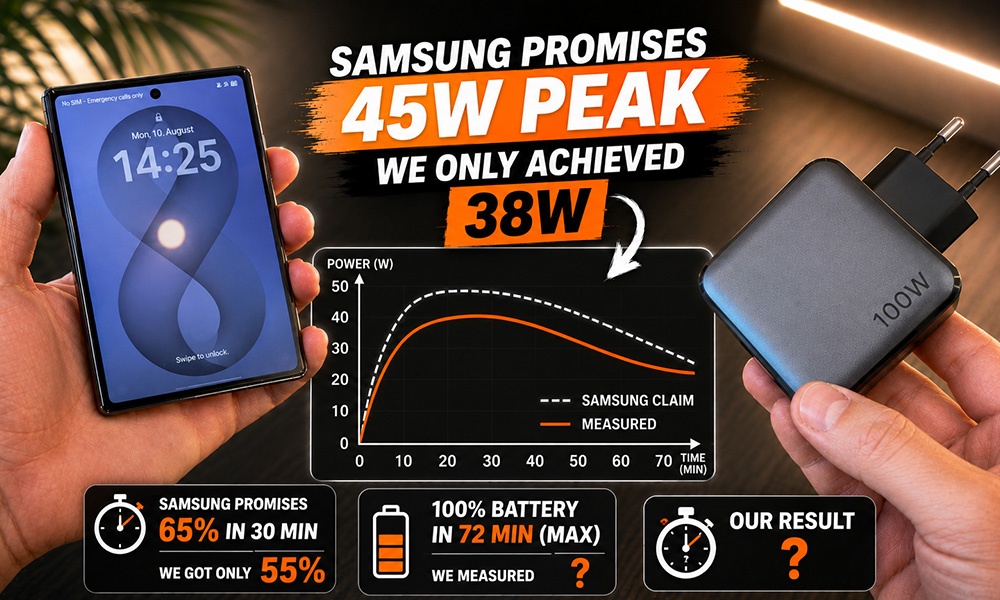
Samsung advertises the Galaxy Z Fold 8 with some impressive numbers: 45 watts of wired charging, 65 percent battery in around 30 minutes, and a full 100 percent in up to 72 minutes. Sounds strong on paper — but do those figures hold up in a real test? I measured it properly: with a 100-watt power supply, the original cable straight from the box, a USB power meter to track the actual wattage going through, and an infrared thermometer for battery temperature. The result is clear, and on one point genuinely disappointing.
The Test Setup: No Room for Excuses
To rule out every possible bottleneck, I deliberately over-specced the setup: a 100-watt power supply delivers far more than the Fold 8 could ever draw. The charging cable came fresh out of the original packaging. Between the charger and the phone sits a USB power meter showing me in real time exactly how much power is arriving. On top of that, I regularly measured the back of the device with an infrared thermometer — because above roughly 40 degrees Celsius, things get critical for a battery.
The starting point: the Fold 8 was completely dead, it wouldn’t even power on. We started at 0 percent, with checkpoints at 10, 20, 30 and 60 minutes.
Is your phone really charging at full speed?
My Charge Check tells you in two minutes whether your charger, your cable or the charging protocol is holding you back – photograph the charger, pick your phone, done. Free, no app, right in your browser.
The First 10 Minutes: 38 Watts Instead of 45
After 10 minutes the battery sits at 28 percent. But the interesting number is the power draw: instead of the advertised 45 watts, a maximum of 38 watts actually came through. That’s the highest figure I saw across the entire charging session — the full 45 watts were never reached once, even though the 100-watt supply offers far more headroom than needed.
At the same time, the thermometer already read 42 degrees on the back. After just ten minutes, the device was sitting in a temperature range where you really don’t want to run a lithium battery for long.
After 20 Minutes: Why the Phone Throttles to 12 Watts
At the 20-minute mark the battery reads 40 percent — and the charging power has collapsed. Instead of the initial 38 watts, it held steady at just 12 watts for an extended stretch. The reason showed up immediately when I measured: shortly before, the case temperature had hit 43 to 44 degrees. In that situation the Fold 8 throttles its own charging power until the temperature drops back below 40 degrees — after which the wattage climbs straight back toward 38.
To be clear, this isn’t a defect — it’s good battery management. The device is protecting its own cell chemistry and preventing premature aging. For the advertised charging times, though, this behavior is a real problem, because every throttling phase costs minutes.
The 30-Minute Mark: 55 Percent Instead of 65
Here comes the first clear deviation from the marketing promise. After exactly 30 minutes, the Fold 8 displayed 55 percent — up to 65 percent was promised. That’s roughly 10 percentage points short: a noticeable gap, not a measurement error.
In fairness, I should name one possible confounding factor: the ideal ambient temperature for charging sits between 16 and 22 degrees Celsius. My test room was at an estimated 28 degrees that day, with no air conditioning. Whether that alone accounts for the full 10-point gap, I doubt — but some portion of it almost certainly traces back to the heat.
The Final Result: 76 Minutes Instead of 72
After one hour the battery stood at 94 percent, the charging power had dropped below 10 watts as expected, and the temperature had settled to a comfortable 37.9 degrees — exactly how the final phase should look. The Fold 8 hit a full 100 percent after 76 minutes. Samsung promises „up to 72 minutes,“ and in my reading, „up to“ means the maximum, not the average.
So in my test, the device missed both advertised figures: 55 instead of 65 percent after half an hour, and 76 instead of a maximum of 72 minutes for a full charge. For me, that’s a test not passed.
Verdict: Failed the Test, But Fine in Daily Use
Criticism aside: 76 minutes from 0 to 100 percent is a solid time for a 4,800 mAh battery in a foldable, and something you can comfortably live with day to day. The deviation is a matter of minutes and will barely register for anyone charging overnight or in the background. What bothers me is more the principle: if you advertise 45 watts, the device should hit that number at least once, even if only for a few minutes at the start.
If you want to treat your Fold 8 well, pay attention to temperature above all: charging on hot days without air conditioning measurably costs you speed and puts extra stress on the battery. And if you want to protect the device from scratches and drop damage too, take a look at our current breakdown of which case actually protects best, along with our detailed test of the best iPhone 17 Pro screen protectors if you’re carrying a second device alongside your foldable.
Did you measure different numbers on your Fold 8? It might genuinely come down to room temperature — I’m curious to hear your experience. More honest measurement tests are coming here regularly.