
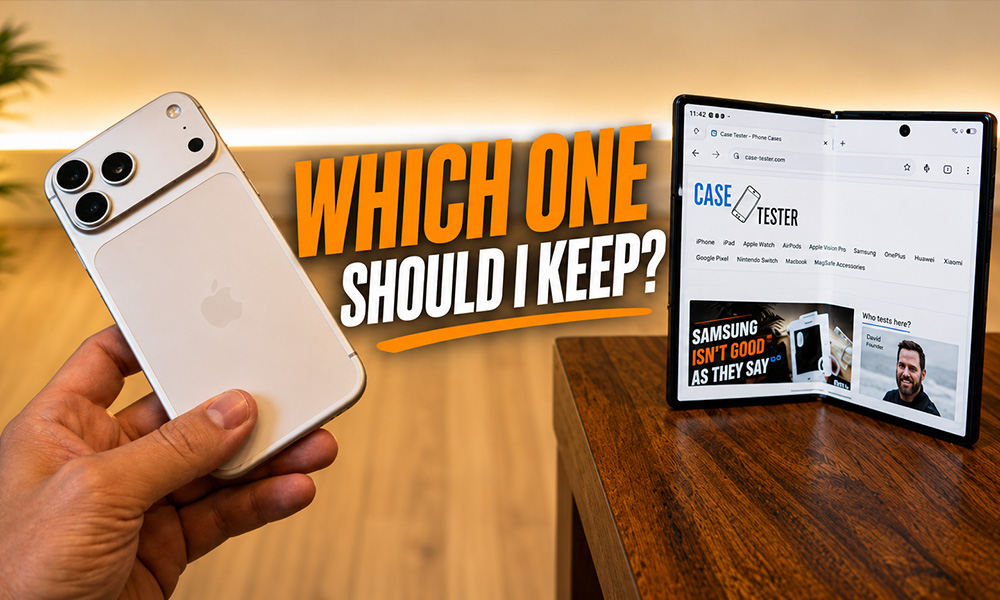
One Week With the Galaxy Z Fold 8 Instead of My iPhone 17 Pro Max: My Honest Verdict
I’ve been living in the Apple ecosystem for years. My apps, my habits, my entire digital routine are built around iOS. A week ago I still picked up the Galaxy Z Fold 8, with one clear question in mind: can a foldable genuinely convince me enough to leave my iPhone 17 Pro Max behind? After seven days, my answer is completely different from what I expected.
Why I Deliberately Didn’t Use the Fold as My Only Phone
I need to explain this upfront, because it frames the entire result. I did not use the Fold 8 as my sole smartphone this week — and that was intentional.
The reason is simple: when you’ve used iOS for years, at some point you know blindly where to go. You stop thinking about workflows entirely. If I claimed after seven days of Android that none of it works, that would simply be unfair — that’s habit talking, not the system.
So I was after a different question: how does this device change the way I use a smartphone? Not: is Android better than iOS? Those are two completely different things.
What Genuinely Annoyed Me About the Fold 8
Let’s start with the friction. The fingerprint sensor sits in the power button, and that’s exactly my problem. With the iPhone I pick up the device, look at it, Face ID, done. With the Fold I grab the phone, hold it differently, and have to deliberately move my finger to the sensor. After a week that still isn’t in my muscle memory. The difference is especially noticeable when the device is lying flat on a table.
Second point: button placement. I reached instinctively for where the iPhone’s volume buttons sit countless times this week. On the Fold they’re somewhere else. Objectively both are small things — but small things like these are exactly what decide whether a device feels intuitive.
And what I genuinely miss is Face ID. Not just for unlocking. With banking, passwords and other sensitive apps, you only realise how deeply that technology is woven into daily life once it’s suddenly gone.
The Surprise: Rebuilding Android With ChatGPT
A viewer comment gave me the idea to switch straight to swipe gestures. That turned into something bigger: I asked ChatGPT how to set up Android so it feels as much like an iPhone as possible — and got a step-by-step guide.
Home screen adjusted, settings changed, gestures reconfigured. Afterwards the device felt considerably more familiar. This is where a real strength of Android shows: I don’t have to adapt entirely to the system, I can adapt the system to me, at least to a degree.
Closed for Quick Things, Open for Everything Else
What struck me most after a week is how often I use the Fold closed. Reading a message, replying briefly, checking the time, changing music, quickly looking something up — the outer display is completely sufficient for that.
But the moment I want to do something for longer, I unfold it automatically. I now find that separation genuinely interesting: small task closed, longer task open. It makes the Fold feel almost like two different devices at times.
The Moment My iPhone Started Feeling Limited
This is the strangest change of the week. I pick up my iPhone 17 Pro Max — a device I know inside out — and it suddenly doesn’t feel right anymore.
Not because it’s bad. But because I know I could unfold the Fold right now and have considerably more display. A week ago a regular smartphone felt completely normal to me. Now I pick up the iPhone and think: why can’t I just unfold this? I never saw that coming.
And that’s precisely where the appeal of a foldable lies. It isn’t about needing a huge display all the time. It’s about having the option to switch. You’ve got a regular phone with you — and when you want more, you unfold it.
Does That Make the Fold 8 Better Than the iPhone?
No, and I don’t want to claim that. For a lot of people the iPhone remains the better choice: if you want a device that simply works, that you’ve known for years and that you never have to think about, that’s where you belong.
But if you fancy something new, if you genuinely want to use your phone differently and sometimes need more screen, a foldable suddenly becomes very interesting.
My Verdict After Seven Days
Would I sell my iPhone 17 Pro Max right now and switch completely? No. A week is too short for that, and my entire digital routine hangs on Apple.
Has the Fold 8 changed my mind? Definitely. I went in intending to check whether this device is even usable day to day for me. Now I’m at a point where I’m saying: maybe I don’t want to go back to a regular smartphone at all.
The Fold 8 isn’t perfect. The fingerprint sensor, the button placement, the missing Face ID, the Android learning curve — all legitimate criticisms. But at the end one thing remains: I voluntarily prefer reaching for the Fold. And for me that’s the most interesting result of this test. Not benchmarks, not technical specs, but the simple question of which device you pick up of your own accord.
What to Consider If You’re Switching
A foldable is considerably more delicate than a conventional smartphone — above all the inner display with its factory-bonded protective film, which must never be removed. If you’re thinking about making the switch, plan the protection in from the start.
Which cases actually protect the Fold 8, and how strongly their magnets hold, we measured with a pull-force gauge — the results are in our full Galaxy Z Fold 8 case comparison. And since the inner display raises the question of whether it can be protected at all, you’ll find the answer and a hands-on test in our Z Fold 8 screen protection test.
How do you see it? Would you switch from an iPhone to a foldable, or are you waiting for the iPhone Fold? Let us know in the comments.