
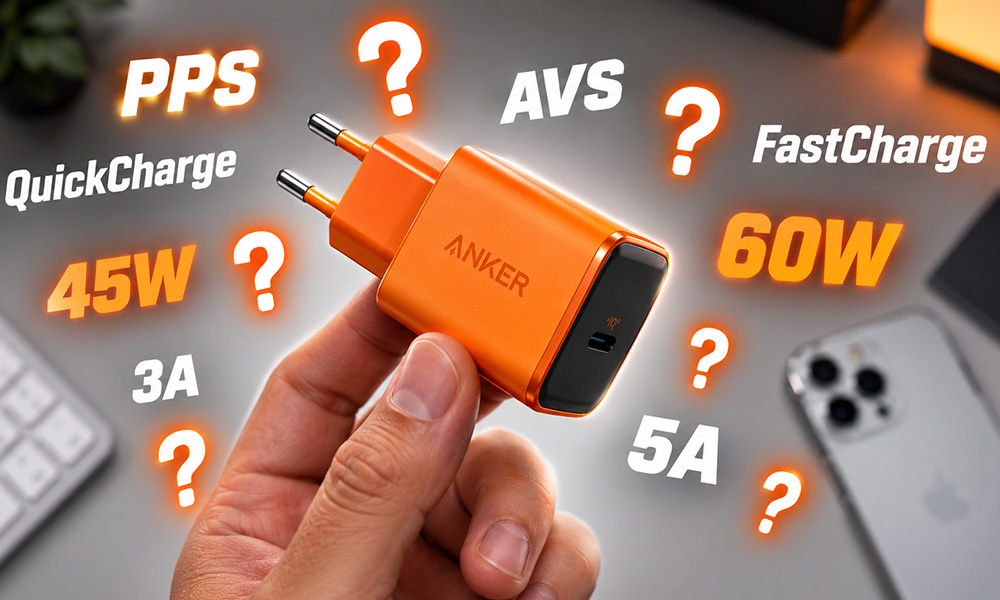
The charger says 45 watts. My iPhone 17 Pro Max takes 40 of that at most – and 36 most of the time. A Samsung takes 27. Or 45. Or 60. Which of those numbers you get isn’t decided by the big number on the front of the charger, but by one small line on the label that hardly anyone reads. In this post I explain what really happens when you plug in, why almost everyone starts at the wrong end – and how to find out without a meter where the brake is in your setup.
Is your phone really charging at full speed?
My Charge Check tells you in two minutes whether your charger, your cable or the charging protocol is holding you back – photograph the charger, pick your phone, done. Free, no app, right in your browser.
The misunderstanding: the first question is never the charger
Most people look at the charger first: 45, 65, 100 watts – the more, the better. But the first question is a different one: what can my phone actually take in? And that isn’t written on the charger, it’s fixed inside the phone. An iPhone 17 Pro Max takes 40 watts at most. A Samsung S26 Ultra up to 60. A regular S26 or a Flip: 25. An older iPhone: 20 to 27. You can’t get past that, no matter what you plug in.
Picture the charger as a glass and the phone as a straw. How fast you drink is decided by the straw, not the glass. Whether there are 45, 65 or 100 in the glass makes no difference to the straw. A bigger glass doesn’t hurt – it just doesn’t help. That decision is made the second you plug in the cable: charger and phone negotiate what gets delivered. And that negotiation has two dialects. The iPhone doesn’t speak one of them.
The staircase: USB Power Delivery
The normal route is called USB Power Delivery, PD for short. Virtually every modern charger can do it. It delivers power in fixed steps: 5, 9, 15 and 20 volts. Like a staircase – nothing in between. But your battery doesn’t want 15 volts at all, it works at about 4. So why does the phone get 15?
Because watts equal volts times amps. Volts are the pressure, amps are the amount that fits through the cable at once – and on a normal USB-C cable that’s capped at 3 amps. 5 volts times 3 amps is 15 watts, and nothing more gets through at 5 volts. If you want 45 watts, the charger turns up the pressure: 15 volts times 3 amps. The cable is fixed, so the charger turns up the voltage.
The catch: the phone receives 15 volts, the battery wants 4. So a chip inside the phone has to convert down – and that isn’t lossless. Picture a tap turned half shut: where you brake, friction is created. With electricity, friction means heat. That’s why your phone gets warm when fast charging, and a warm phone throttles itself. Fast for the first few minutes, then it brakes.
The ramp: PPS on Samsung and Pixel
PPS stands for Programmable Power Supply. Instead of a staircase, a ramp: the phone says „give me 8.7 volts,“ and the charger sets exactly 8.7 volts, in steps of two hundredths of a volt. The chip in the phone barely has to convert any more, the charger does the main work. The charger gets warmer, the phone stays cool – and a cool phone is allowed to charge fast for longer. Samsung calls it Super Fast Charging.
But PPS isn’t a yes-or-no question. The real trap is a number behind it that often isn’t even printed. The Anker Nano 45 W can do PPS – but only with 3 amps, not 5. A Galaxy S24 Ultra wants 5 amps for its 45 watts. Result: 9 volts times 3 amps, 27 watts. Anker states that on its own product page. And a 5 amp cable doesn’t help – a cable can only brake, never accelerate. For the full 45, all three have to do 5 amps: charger, cable, phone.
Since the S25 Plus, Samsung has gone the other way: not more amps, but more volts. 45 watts are now 15 volts times 3 amps, the S26 Ultra’s 60 watts are 20 volts times 3 amps. That’s why the cable from the box is enough on a new Samsung. But now a different number counts: how high does the ramp go? If it ends at 11 or 16 volts, there are no 60 watts – no matter what’s printed on the front.
Reading the label
The first line on my 67 watt charger reads: 5 V 3 A, 9 V, 12 V, 15 V, 20 V. Fixed values – the staircase. The second line: PPS 3.3–20 V, 3.35 A. A range with a dash – the ramp. Both numbers are in that one line: at the front the volts up to 20, which is enough for every new Samsung up to the S26 Ultra. At the back the amps, 3.35 – not enough for an S24 Ultra, which wants 5. Once you can read that line, you know for any charger what it can do for your phone.
And the iPhone? AVS instead of PPS
The iPhone can’t do PPS and never could. But since the iPhone 17 it can do something that works almost the same way: AVS, Adjustable Voltage Supply, part of the new PD 3.2 standard. Also a ramp, in steps of a tenth of a volt instead of two hundredths. Same idea, different name. In measurements the iPhone 17 Pro Max briefly reaches just under 40 watts when the battery is empty and cool, then settles at 36. That’s what the measurement pros at ChargerLAB found, and I get the same 36 watts.
The advantage is the same as with PPS: the heat moves into the charger. And Apple keeps it simple – every normal PD charger works on the iPhone, you can’t buy wrong. The downside: your old charger can’t do AVS. For that you need one with PD 3.2 on the box. So for the iPhone: no PPS needed, no wattage above 40 needed, a normal 3 amp cable is always enough.
The two brakes that aren’t written on any charger
First, the cable. Up to 60 watts a 3 amp cable is enough, because 20 volts times 3 amps is 60. Above that you need 5 amps: 20 volts times 5 is 100 watts. That’s laptop and tablet territory – and Samsung up to the S24. From the outside, 3 and 5 amp cables are indistinguishable, and no phone in the world can read a cable.
Second, and this is the most common brake of all: USB-A. The wide old plug. If there’s a USB-A anywhere in your chain, the iPhone stops at 12 watts, Android at 15 to 18. No matter what the charger says, no matter which cable. Because the fast negotiation between phone and charger only works over USB-C. USB-A is a kink in the straw. It’s in the old charger from two phones ago, in the multi-port adapter in the car, in the power bank with the wide output, in the hotel bedside lamp. My 67 watt charger lists 45 watts for its USB-A port. The iPhone gets 12 out of it.
Charge Check: know where the brake is in 15 minutes
Because exactly this annoyed me so much, I built a tool. Charge Check runs free in your browser and follows the rules from this post. It detects your phone by itself – from display size and refresh rate – and knows how much it can draw at most. Then you photograph your charger’s label, and the page reads wattage, voltage steps and PPS range using AI. If there’s a USB-A in the chain, you get the diagnosis instantly. Everything else is measured by the clock: enter a battery level under 40 percent, plug in, display off, leave it for 15 minutes, enter the new level.
The result is a process of elimination. Charger can do 45, phone takes 45, 27 arrived – then the cable is the most likely suspect. And if everything fits, the tool says exactly that: don’t buy anything. That’s the sentence you won’t read on any sales page. To be honest: it’s a rough classification, not a meter. It tells 5 from 20 from 45 watts. It doesn’t need to do more.
The combo that does everything
If you can’t be bothered with any of this: a UGREEN 100 watt charger with PD 3.2 and AVS for the iPhone 17, PPS up to 21 volts for the new Samsung, 5 amps for the old Samsung – plus a 5 amp cable for around $8. With that, every iPhone, every Samsung, every Pixel and every laptop up to 100 watts charges at the maximum the device allows. The only exception: phones with their own turbo protocol like Xiaomi or OnePlus at 100 watts and more – those want their own charger.

- Smart Digital Display with Touch Control: The visible monitoring wall charger allows easy switching between real-time charging data via its touch panel. The displayed data includes total output power, individual port power, charging protocol (PD/QC), real-time device battery level and charger core temperature, enabling you to grasp all charging details at a glance and avoid overcharging risks
- 100W PD High-Speed Fast Charger: UGREEN GaN USB C charger delivers 100W max PD fast charging, rapidly powering slim laptops, smartphones and tablets. This USB C laptop charger charges Macbook Pro M4 14'' to 54% in just 30 minutes, eliminating the need for bulky original laptop chargers
- 5-in-1 Multi Port USB C Charging Adapter: The 100W PD fast charger features 4 USB-C ports + 1 USB-A port, supporting simultaneous fast charging of up to 5 devices at once; it has intelligent power distribution technology that avoids power competition between devices, ensuring stable charging for all connected electronics
- Multi-Layer Safety Certified: UGREEN reliable protection PD fast charging adapter complies with local electrical safety standards, built-in over-voltage, over-current, over-heat, short-circuit and over-charge protection; the intelligent temperature control system automatically adjusts power when overheating, safe for all-day and overnight charging for all USB-C/USB-A enabled devices
- Portable & Fire-Resistant Design: UGREEN 100W PD charger block features a foldable plug, making it an excellent choice for road trips and daily commutes; premium PC material and a 94-V0 fire-resistant shell ensure its durability

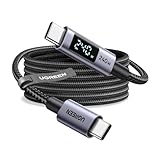
- 240W MAX Super-Fast Charging: The high speed usb c cable supports PD 100W protocol, 48V/5A high-power output, and can charge an iPhone 17 Pro Max to 50% in 20 minutes
- Intelligent Digital Display: Exclusive LED screen monitors charging status in real time: cyclically displays power (W), current (A), and voltage (V), with automatic switching every 3 seconds (display sequence: power → current → voltage), accurately monitoring device power input and preventing overcharging damage
- Efficient Dual-Channel Transmission: The usb c display cable supports 480Mbps data transfer speeds for ultra-fast file/video transfers; built-in E-Marker chip (located on the non-display side) ensures high power, safe, and stable operation
- Extremely Durable Design: 24-strand high-density braided cable resists tearing and abrasion, space gray aluminum terminal blocks dissipate heat and prevent oxidation, PC lens protects the screen against scratches (factory-installed with protective film), and certified for 10,000-cycle bend testing
- Flexible scenario adaptation: three sizes are available (1m for car, 2m for home, and 3m for conference projection), EMI certified and interference-free, compatible with Type-C devices such as iPhone 15-17 series, Samsung S25, and MacBook

- High-Powered 240W Charging: Experience unparalleled speed as you power up your MacBook Pro 16" to 42% capacity within 30 minutes.
- Charge Without Boundaries: From MacBook to iPad, Samsung phones, and beyond, this Anker USB-C cable offers a charging solution that suits a diverse range of devices.
- Unbreakable Double Braided Nylon: Enjoy rapid charging and exceptional resilience with a 10,000-bend lifespan*, built to endure the rigors of daily use.
- Secure Charging Guarantee: Charge with peace of mind using our USB-IF compliant cable, designed to meet the highest safety standards.
- What You Get: Anker USB-C to USB-C Cable (6 ft, 2pack, 240W, Braided), welcome guide, our 24-month worry-free warranty, and friendly customer service.
Bonus: fast charging doesn’t harm the battery – the night at 100 percent does
A phone battery has two enemies: heat and a full charge over a long time. At 100 percent it sits at the highest voltage it can tolerate, and that’s stress for the cell chemistry. Fast charging does warm the phone, but it throttles itself as soon as it gets too warm – it practically never exceeds 40 degrees Celsius. Fast charging is the short phase. Holding full overnight is the long phase, and the long phase is what counts.
What helps costs nothing: a charging limit of 80 percent, in the battery settings on Apple and Samsung alike. If you need the full 100 in the morning, leave optimized charging on – then the phone charges to 80 overnight and does the last 20 shortly before you get up.
Pros and cons of the three charging routes
✓ PD (staircase): works with every charger, every power bank, on every phone
✓ PPS (ramp): phone stays cool, keeps its pace longer, battery ages more slowly
✓ AVS (iPhone 17): same coolness as PPS, and every PD charger still works
✗ PD: the heat is created in the phone, it throttles after a few minutes
✗ PPS: only with the right charger – and 3 or 5 amps, or 20 volts, decide
✗ AVS: only new chargers with PD 3.2, older iPhones get nothing from it
Verdict: three sentences to take away
First: know what your phone can do first – then look at the charger. The watts on the charger are only the glass, the straw is your phone. Second: Samsung needs PPS – up to the S24 the 5 amps, from the S25 on the 20 volts. The iPhone needs none of it. Third: USB-A anywhere in the chain, and it’s over at 12 to 18 watts, no matter what the label says.
And if your iPhone needs accessories anyway: a good case must not get in the way of MagSafe or the cable – which ones manage that is in my roundup of the five best iPhone 17 Pro cases right now.