
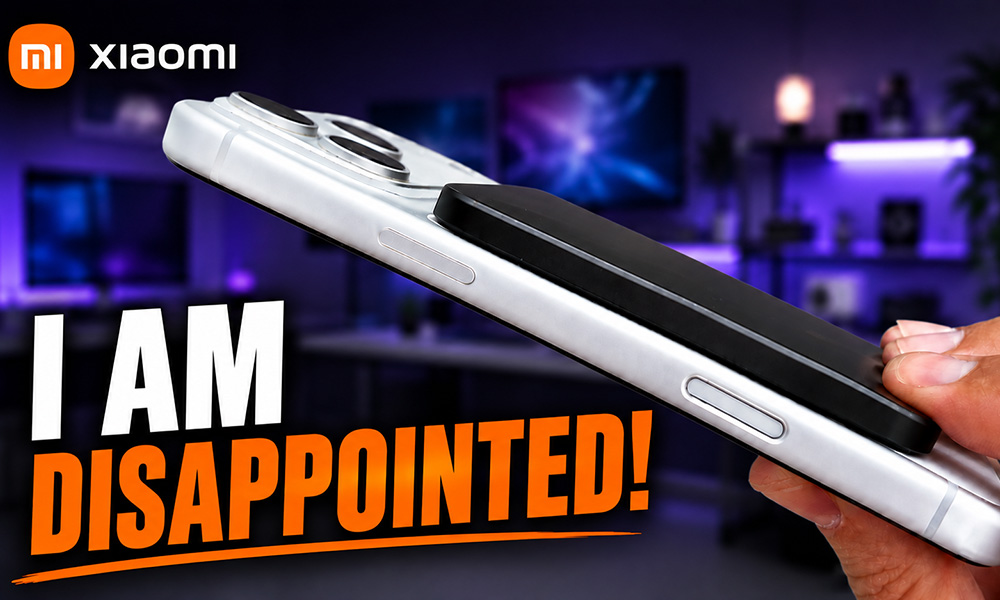
Six millimeters. That’s the number Xiaomi sells this power bank on, and it’s exactly right — I checked it with a caliper. It’s supposed to weigh 98 grams; my scale says 99, though Xiaomi’s own product images flip between 98 and 99 anyway. Fine. At 5000 mAh that is genuinely impressive, and the comparison makes it obvious: the Anker MagSafe power bank I tested recently is 8.6 millimeters thick and weighs 122 grams. So the Xiaomi is almost a third thinner and noticeably lighter — at identical capacity.
And yet this thing has noticeably bad reviews. That’s exactly why I ran this test. Because the criticism in those reviews is partly justified, partly completely wrong — and the real catch isn’t in either place.

- Ultra-Slim Qi2-Compatible Magnetic Power Bank: At just 0.3 inches thin, this ultra-slim power bank supports Qi2 certification and offers 5,000mAh of reliable wireless charging, making it a travel essentials for daily carry and among the trusted iPhone power banks available.
- Enhanced Safety and Speed: Experience high-speed charging with enhanced safety. Qi2 MagSafe compatibility, temperature protection, and up to 20W max USB-C output.
- 15W MagSafe-Compatible Charging: Get up to 15W max of Qi2-certified fast wireless charging—enough to power an iPhone 16 Pro to 25% in just 42 minutes. (Note: Data based on internal lab testing; actual performance may vary.)This product is designed for iPhone. We do not recommend using it with Android phones, as differences in fit or alignment may affect placement or result in slower charging speeds.This power bank is flight-approved and complies with air travel regulations in the United Sates and most countries. Howeveer, it does not haveChina's 3C certification and cannot be carried on domestic flights within China.
- 104℉ for Safer Handling: Designed with graphene cooling, dual NTC chips, and smart heat control, the device stays below 104°F, 14 degrees cooler than industry standard for safer charging with temperature protection built in.
- What You Get: Anker Nano Power Bank (5K, MagGo, Slim), USB-C to USB-C charging cable, welcome guide, 24-month warranty, and our friendly customer service.
Why it can be this thin
The trick is in the cell. Instead of pure graphite, the anode material here uses silicon. Silicon stores considerably more energy in the same volume, which is why the same 5000 mAh fit into a much flatter cell. That’s real engineering, not a marketing trick. The catch is that you pay for that form factor in two places, and I measured both.
Is your phone really charging at full speed?
My Charge Check tells you in two minutes whether your charger, your cable or the charging protocol is holding you back – photograph the charger, pick your phone, done. Free, no app, right in your browser.
The 15 watts never arrive — and Xiaomi knows it
Xiaomi advertises „up to 15 watts of wireless charging via MagSafe.“ The Amazon listing shows an iPhone, it talks about MagSafe, it talks about 15 watts. Any normal buyer draws one conclusion from that — and it’s the wrong one.
I started an iPhone 17 Pro Max at exactly 20 percent battery, display off, airplane mode on, and charged for 15 minutes. Result: five percentage points. Converted, that puts roughly 3.8 watts into the battery, with the power bank putting out about 5.6 watts. For context: a Qi2 certified device would be allowed to deliver 15 watts to an iPhone. We’re at a good quarter of that.
The reason isn’t weak electronics, it’s a missing approval. This power bank has no Qi2. Without that certificate from Apple it isn’t permitted to charge an iPhone at 15 watts at all, no matter how capable it might be. And Xiaomi does state this — in tiny print, at the bottom of the product images: „iPhone brand devices support up to 7.5 watts of magnetic wireless charging.“ So small that essentially nobody reads it. That is precisely where the bad reviews come from. The power bank isn’t weak; the listing is misleading.
Over cable, on the other hand, it looks genuinely good. It’s rated at 22.5 watts and my power meter showed a steady 21.1 watts across the whole measurement. That’s a clean number, and the iPhone charges visibly faster with it. Charging the power bank and the phone simultaneously also works without any limitation.
The real catch: holding force
For me this is the clearest result of the entire test. I pulled on both power banks with a pull force gauge, three runs each, peak value in kilograms.
The Anker holds on with 1.01 kilograms. The Xiaomi with 0.52 — averaged from 0.52, 0.50 and 0.59. That’s barely half, on a device whose only job is to stick to your phone. And you notice it the moment you pick it up: the thing slides around on the back and comes off with the slightest movement. That, too, is a direct consequence of those six millimeters — thicker magnets simply don’t fit in there.
If you pick your accessories by fit rather than by millimeters, my roundup of the strongest iPhone 17 Pro cases also identifies the models where MagSafe still grips reliably through the case — which matters even more with a power bank this weak.
Pocket heat: here I disagree with the reviewers
A recurring accusation is that the device gets so hot in your pocket that it barely charges any more. One reviewer writes about getting 5 to 10 percent over several hours. I can’t confirm that — not remotely.
I carried the power bank and iPhone in my pocket for 15 minutes, warm side directly against my leg. Result: four percentage points instead of five, so about 20 percent slower. The temperature climbs from 35 to 37 degrees Celsius. A lithium battery only enters critical territory above roughly 40 degrees — so the battery isn’t taking any damage here.
Something else was more interesting: I measured both sides, the power bank and the back of the iPhone. Both sat at the same 35 degrees. Thermally, the two are a single block. The phone can’t shed heat out the back, because the power bank is stuck there like a blanket.
And I have a suspicion I explicitly have not proven: if a power bank only holds on with half a kilo, it slips while you walk, or falls off. Then nothing charges at all. That would explain those reviewers‘ experience considerably better than heat does. I’ll test that separately.
Being honest about the numbers
These values come from 15-minute measurements. That’s enough for the direction, but not for the decimal place. iOS only displays whole percent, and at five percent a one-point reading error is already a 20 percent measurement error. So I’m running both tests again for a full hour and will follow up with the exact figures.
Pros and cons
✓ Measured at 6.0 mm, the thinnest power bank you can buy
✓ 99 grams — almost a quarter lighter than the Anker at the same capacity
✓ A steady 21.1 watts over cable, a very clean result
✓ Charging the power bank and phone at the same time works without issues
✓ Temperatures stay harmless, even in a trouser pocket
✓ All output ratings are printed on it, so taking it on a flight is settled
✗ No Qi2 — only 7.5 watts are permitted on an iPhone, not the advertised 15
✗ Holding force of just 0.52 kg, roughly half the Anker’s
✗ Slides around on the back and detaches easily when you move
✗ The Amazon listing implies a charging rate the device isn’t allowed to deliver
✗ Measured wirelessly, only 3.8 watts reach the battery — a good quarter of Qi2 level
Verdict
About $55 for the thinnest power bank money can buy. If thinness beats everything for you, because it has to fit in a shirt pocket, then it has no competition — there simply isn’t anything flatter. But if you’re buying it to charge, the same money gets you a Qi2 device that charges twice as fast and holds on twice as tight.
I’d have loved to say those six millimeters are a miracle. They’re a trade-off — and you should know what you’re giving up for them. If your iPhone still needs protection anyway, it’s worth checking the three screen protectors that actually survived my testing first — together they cost less than this power bank and prevent damage that’s genuinely expensive.