
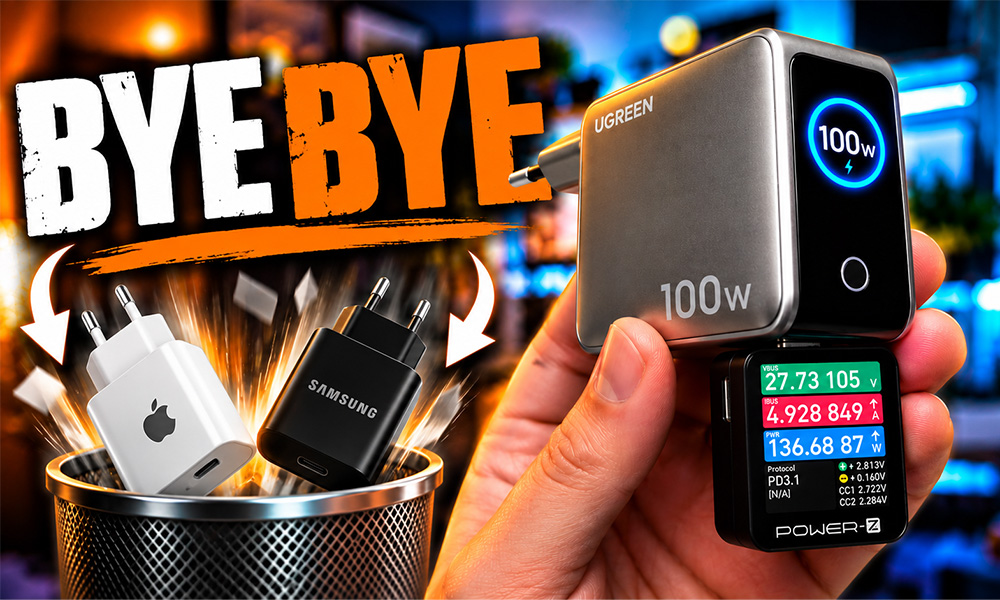
UGREEN Nexode Pro 100W Review: One Charger for MacBook, iPhone and Samsung?
One charger for everything — that’s the promise of the UGREEN Nexode Pro with 100 watts. PPS for Samsung, AVS for Apple, enough power for a MacBook, plus a built-in display. I didn’t take their word for it, I measured it. With a $120 power meter, across six tests. It passed five. One went wrong, and I’m showing you that one just the same.
Test 1: can it handle the MacBook?
Easiest test first. My MacBook Air pulls a maximum of 70 watts, the charger can do 100. Plugged in at 40 percent battery, the figure climbs quickly: 54 watts, 69, then a steady 70 watts on the meter. Exactly what the notebook takes at most. Passed.
One thing matters here: this test needs the thicker 5 amp cable. Why, more on that shortly.
Test 2: does PPS work with Samsung?
PPS is Samsung’s charging protocol. In short: the phone tells the charger exactly how many volts it needs, instead of stepping the voltage down inside the device itself. That way the heat is created in the charger and not in the phone — and a cool phone charges fast for longer.
Oddly enough, there isn’t a word about PPS on the packaging. On the meter there certainly is. At 52 percent battery the Galaxy S26 Ultra pulls 45 watts, and underneath the line „PD 3.0“ it says PPS in small letters. At a lower battery level it would have been the full 60 watts. Passed.
Test 3: and AVS on the iPhone? This one went wrong
AVS is Apple’s version of the same principle, on board since the iPhone 17. The charger supports AVS — it’s even in its own power table, which I read out in the video. The iPhone 17 Pro Max supports AVS. So the combination ought to charge faster than a charger without it.
It doesn’t. The meter shows PD 3.0 instead of AVS, and across the whole measurement the iPhone never goes above 27 watts. For comparison: in the same test with the Anker Nano 45W, the clock showed 36 percent after ten minutes. Here it’s only 31.
I measured the device at 38 degrees Celsius afterwards, so room temperature could play a part — the earlier test ran in the basement at exactly 20 degrees. But that doesn’t explain why the protocol never gets negotiated in the first place. I have no explanation for this. Next week the iPhone 18 Pro Max arrives, which charges at 60 watts, along with Apple’s own AVS charger. Then I’ll test them head to head.
Test 4: does the display tell the truth?
Plenty of chargers with displays round generously. This one doesn’t. The readout on the charger matched my external meter across every measurement. Honestly, I’d expected less. Passed.
Test 5: what’s the 5 amp cable for?
This is the aha moment of the video, and it affects everyone buying a 100 watt charger. Plug in a normal 3 amp cable and the charger’s power table shows a maximum of 60 watts — even though the casing says 100. Only with the 5 amp cable does 100 appear there.
The maths behind it is simple. Over USB-C there are a maximum of 20 volts. 20 volts times 3 amps is 60 watts, and that’s the ceiling for any normal cable. For more you need 5 amps: 20 times 5 is 100 watts. The cable decides, not the charger.
In practice that means: up to 60 watts the thin cable from your phone box is perfectly fine. For notebook and tablet you need the thick one. And since a cable like that costs only around $11, I’d simply buy it alongside — you can charge your iPhone, Samsung and AirPods with it too, nothing bad happens.
Pros and cons
✓ The full 70 watts on the MacBook, up to 100 watts with the right cable
✓ PPS works with Samsung, despite not being stated on the packaging
✓ The built-in display shows exactly the same values as an external meter
✓ Replaces your Samsung, Apple and notebook chargers with one device
✓ Around $50, roughly $60 with the cable — far cheaper than three separate chargers
✗ My iPhone 17 Pro Max didn’t use the AVS protocol, cause unresolved
✗ 31 instead of 36 percent after ten minutes compared to a simpler 45 watt charger
✗ PPS isn’t printed on the packaging even though it works
✗ Without a 5 amp cable you only get 60 watts instead of 100
Verdict: buy it or not?
Yes, I recommend it — with one open question. For Samsung, notebook and tablet it delivers what it says. On the iPhone the AVS question stays open, and I’ll settle that next week with the 18 Pro Max and Apple’s own charger, which also supports AVS.
The real value is that you only need one device from now on. No separate Samsung charger, no separate Apple charger, no notebook charger. Even if phones climb to 100 watts at some point, you’re covered. Around $60 for charger and cable, and the topic is settled for years.
If you want to know beforehand whether your current combination has a bottleneck at all, check it with my free Charge Check in the browser. It detects your phone by itself and reads your charger’s label from a photo.
And if a new iPhone is on the cards anyway: which case actually fits is in my iPhone 18 Pro case comparison, and the right glass is in the 18 Pro screen protector test. For the foldable those tests run in parallel — cases for the iPhone Duo and the screen protection for the iPhone Duo, including the tricky question of the inner display.