
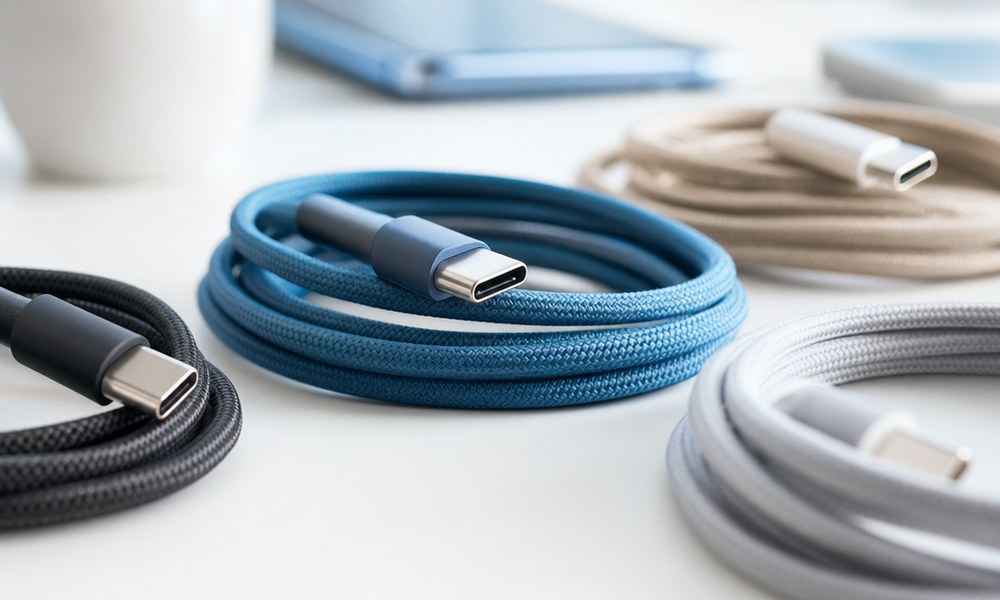
Cable shopping has become absurd. „100W“, „240W“, „USB4“, „e-marker“, „PD 3.1“ – and all of it for a phone that takes 27 watts. The truth is simpler than the packaging: for almost every phone, a plain 3-amp cable is all you need, and there is exactly one group of phones that needs more. Here’s how to tell which group you’re in, and which three cables I’d actually buy.
What a USB-C cable really decides
A USB-C cable has one job for charging: carrying current without getting hot. There are two classes. A 3-amp cable carries up to 60 watts (20 volts × 3 amps). Every USB-C cable that meets the spec is at least a 3-amp cable – including the one in your phone’s box. A 5-amp cable carries up to 100 watts, and a 240W cable up to 240. Both need an e-marker, a tiny chip in the plug that tells the charger „I can take 5 amps“. Without the chip, the charger plays it safe and stays at 3 amps – even if the cable is thick as a rope.
The cable doesn’t make anything faster. It can only hold things back. And from the outside, 3-amp and 5-amp cables look identical.
Is your cable holding your phone back?
You can’t see it from the outside – but you can measure it. My Charge Check first rules out charger and protocol from a photo of the label, then a 15-minute test shows live whether the cable is the bottleneck. Free, no app, no meter.
Who needs which cable
- Every iPhone (12 through 17): 3 amps. The iPhone 17 tops out at 40 watts, well under the 60-watt limit of a 3-amp cable. A 240W cable is wasted money here. On the iPhone 14 and older with Lightning, the only rule is MFi certification – without it the iPhone throttles.
- Galaxy S25, S25 Ultra, S26 series, Fold 8, Flip 8: 3 amps. Since the S25, Samsung pulls its 45 watts at about 13.5 volts and 3 amps. Any regular USB-C cable does it.
- Galaxy S23+, S23 Ultra, S24+, S24 Ultra: 5 amps. These are the exceptions. They draw 45 watts at 10 volts and 4.5 amps, and a 3-amp cable caps them at 27 watts. Which charger goes with that is in my post on the Samsung 45W charger.
- Pixel, regular Galaxy, Galaxy A series: 3 amps. They all stay under 30 watts.
- Xiaomi and OnePlus with 80 to 120 watts: the original cable. Their proprietary protocols run at 6 amps and more over a cable only the manufacturer makes.
- Laptops: 5 amps if the laptop draws more than 60 watts – MacBook Pro 14 and 16, gaming laptops.
So the honest answer for most people: your cable is fine. If your phone charges slowly anyway, the problem is almost always further up the chain – USB-A, a weak charger, or a missing protocol. The order to check is in my post Why Is My Phone Charging So Slow?.
The three cables I’d buy
1. Anker USB-C to USB-C Cable 60W, 2-pack – the everyday cable
3 amps, 60 watts, two cables for the price of one, and Anker’s cables survive years of pocket abuse. This is the right cable for every iPhone, every Pixel and every Samsung from the S25 on. About $10 for two.
See the Anker 60W USB-C cable 2-pack on Amazon*
2. UGREEN USB-C Cable 240W – the 5-amp cable for under $10
5 amps, e-marker chip, PD 3.1, braided. This is what an S24 Ultra needs for its 45 watts, and it charges a MacBook Pro at full speed. At about ten dollars there’s no reason to buy a 3-amp cable if you own any device that needs more. 6.6 feet.
See the UGREEN 240W USB-C cable on Amazon*
3. Anker USB-C Cable 240W, 2-pack – the same thing, twice
Same class as the UGREEN: 5 amps, e-marker, 240 watts, braided, 6 feet. If you want one for the desk and one for the bag, this pack is the cheaper way to get two. Take whichever of the two is on sale today – they’re interchangeable.
See the Anker 240W USB-C cable 2-pack on Amazon*
What you can ignore on the packaging
- „USB4“ and „40 Gbps“: data transfer speed. Irrelevant for charging, and it triples the price.
- „Supports 100W/240W“: only matters if you own a device that draws that much. For a phone, 60 is plenty.
- „Fast charging cable“: means nothing. Every USB-C cable that meets the spec is a fast charging cable.
- Length: up to 6.6 feet makes no measurable difference. Beyond that, cheap cables start to lose a bit.
When a good cable still charges slowly
Two things ruin even the right cable. First, damage: a kink near the plug, a loose contact, a frayed braid. Second – and far more common – lint in the phone’s charging port. The plug no longer seats fully, the contact goes bad, and everything looks like a cable problem. Flashlight, look inside, wooden toothpick. And since we’re talking about a phone you want to keep for years: the outside matters as much as the port. My tests of my iPhone 17 Pro case comparison and which screen protector fits the iPhone 17 Pro best show what actually survives a drop.
In short
Buy a 3-amp cable unless you own a Galaxy S23+/S23 Ultra/S24+/S24 Ultra or a laptop over 60 watts – then buy the 5-amp cable for ten dollars and be done. If your phone charges slowly, the cable is the last suspect, not the first. And if you want certainty instead of guesswork, the Charge Check rules out the charger from a photo and tests the cable in 15 minutes. The full technical background is in Fast Charging Explained: PD, PPS, AVS.