
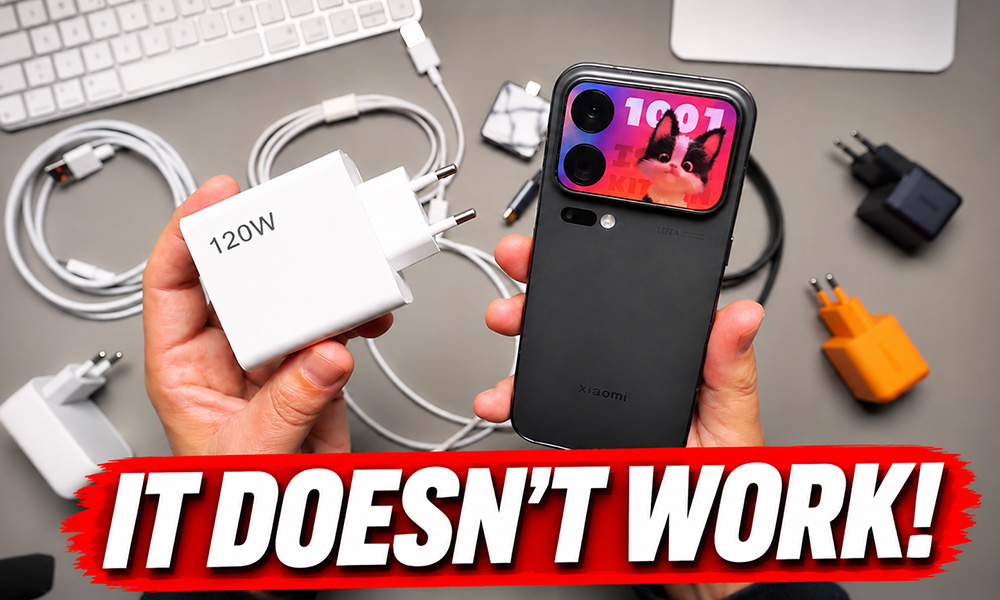
Xiaomi rates the 18 Pro at 90 watts over the cable and ships it without a charger. The spec sheet simply recommends using a 100-watt adapter or better. So I pulled out everything I had in the drawer, put a meter between charger and phone, and measured which of it actually does anything. The result is sobering: out of six combinations, not one went past 55 watts.
And the most expensive misunderstanding turned out to be the charger I bought specifically for this test.
Before the numbers: if all you want to know is whether your own charger and cable deliver full speed on your phone, you do not need a meter for that. That is exactly why I built the Charge Check: pick your phone, photograph the label on your charger, and you see straight away whether the combination fits or what is slowing it down. Free, no app, no sign-up.
How I measured
Every run used the same phone under the same conditions: airplane mode on, starting at 5 percent battery, everything in the system set to maximum charging speed, room temperature 21.4 degrees Celsius. A USB-C meter sat between charger and phone showing voltage, current and power live. I was not after a full charging curve, just one question: how many watts does the phone actually accept?
One detail a lot of people skip: the cable is part of the measurement. So I ran every charger with different cables, from 3 amps up to 6 amps.
The 120-watt copy: cheap, and good for 30 watts
Keine Produkte gefunden.
Xiaomi’s own set would have taken over a week to arrive and cost around 30 euros. So I ordered a charger from Amazon instead — 120 watts promised, explicitly made for Xiaomi, HyperCharge listed in the product description, for about half the price. The housing even carries the same voltage table as the original.
Plug it in and the phone dutifully reports fast charging and displays „90 W max“. The meter showed 30.8 watts — roughly 16 volts at 1.9 amps. The bundled 6-amp cable would have carried far more, but the phone never pulled past 2 amps. It made no difference how long I left it connected, and none when I swapped in the original 6-amp cable: 30 watts was the ceiling.
That is not a faulty unit, it is a protocol problem. HyperCharge is Xiaomi’s own fast-charging standard, and for it to work, phone and charger have to speak the same language. According to Xiaomi only its official chargers do; anything else gets less power. This copy clearly handles neither HyperCharge nor fast USB-C charging properly, so the phone falls back to standard charging. You pay for 120 watts and get 30.
USB-A is the biggest brake of all
An older UGREEN rated at 100 watts made it even clearer. Through its USB-A port the 18 Pro charged at 8 watts. The same charger over USB-C: 50 watts. One port difference, a factor of six. If you are still using an older charger with the flat USB-A plug, you can skip the measuring entirely. I wrote up why in fast charging explained: PD, PPS and AVS.
45 and 60 watts are not enough — and the cable will not save you
Next came the chargers most people actually own. The 45-watt Anker delivered 23 to 24 watts on the 3-amp cable, and the phone stopped reporting „90 W max“ and switched to Turbo Charge instead. Then I plugged in the 5-amp cable, and nothing changed. Nothing got past 3 amps, because the charger itself cannot do more.
This is the part the number on the box hides. What decides the outcome is not the headline wattage but the PPS line on the label. Plenty of 45-watt chargers only run their PPS stage up to 11 volts at 3 amps, which caps you at 33 watts on paper no matter which cable you use.
Apple’s own charger, rated up to 60 watts, landed at 27 watts — 3 amps at 9 volts. Notably, the phone did not recognise a matching protocol here at all. A thicker cable did not improve it. At 10 percent battery and 21 degrees in the room it was not down to heat or state of charge either. That is simply not fast charging. I saw the same pattern on the iPhone 18 Pro, where 60 watts also falls short.
The winner in this field: UGREEN Nexode Air 65 W
The newest charger in the test was the UGREEN Nexode Air at 65 watts. On the 3-amp cable the phone announced 60 watts and then drew about 50 watts — 3 amps at 17 volts. So the protocol was recognised here, unlike with the Apple unit.
The 5-amp cable pushed it further: the charger announced 67 watts, the meter read 53 to 58, settling at around 55 watts. And only in this run did my meter display the word „Xiaomi“ for the first time.
The only reason it stopped there is that the charger itself tops out at 65 watts. The same series exists with more power, and I would expect a stronger version to reach the full 90. I have not measured that yet — if you own one of those along with an 18 Pro, post your reading in the comments.
What you actually need for full speed
Two routes come out of this test, and both work.
Route one: Xiaomi’s own set. Charger plus cable, around 30 euros in Germany, and the 90 watts are there. Use the cable from that set, though — it is rated for 6 amps. The catch is the port: the charger is USB-A, so an iPhone will not fast-charge on it. You end up with a charger for exactly one device.
Route two, which I prefer: a normal USB-C charger, but the right one. Turn it over and read the label. It needs a PPS line that reaches roughly 20 volts, and it needs 5 amps. USB-C will not carry more than 5 amps, so 90 watts means you need close to the full 20 volts. Add a 5-amp USB-C cable, which you can spot by the 100 W or 240 W marking — see my notes on which USB-C cable actually carries the current. That combination then charges every other phone in the house as fast as it can go.

- 65W Fast Charging Efficiency: Power up your MacBook Air M3 to 51% in just 30 minutes with the 65W 3-port GaN charger, ensuring you stay productive on the go
- 3-Port Convenience: Equipped with 2 USB-C ports and 1 USB-A port, it simultaneously charges multiple devices, including laptops, smartphones, and tablets, with ease
- Travel Friendly, Compact Design: Thanks to a cutting edge GaN chip, Ugreen's 65W USB C charger is 50% smaller than the original 61W USB C charger; A foldable plug provides more portability and a better travel experience
- Adopted GaN Safety & Efficiency: Utilizing GaN technology, this 65W power adapter provides safe, cooler charging to protect your devices while optimizing energy usage
- Universal compatibility: Designed to work perfectly with a wide range of electronic devices, this 3-Port USB-C charger can charge devices from phones to laptops ( MacBook , iPad Pro, iPhone 17/16/15 Series, Galaxy S25/S24, Steam Deck, and More ), enhancing connectivity and convenience

Is the original worth it at all?
GSMArena measured both against each other on the 18 Pro. With Xiaomi’s charger they hit 69 percent after 30 minutes; with a regular 100-watt USB-C charger, 67 percent. Only the last stretch to full takes longer: 71 minutes instead of 51. Nobody notices two percentage points after half an hour, and most people do not charge to 100 percent anyway.
My verdict: skip the cheap HyperCharge lookalike, it is not worth the money. Buy a proper USB-C charger with the right PPS line and a 5-amp cable, and every device in your household benefits, not just the Xiaomi.
And if it is protection rather than charging you are after: for the iPhone 18 Pro I tested the current cases one by one and put the screen protectors head to head. Which charger are you using on your Xiaomi, and has anyone got past 55 watts? Let me know in the comments.